Private Kenneth Townsend, Buried in St John the Baptist Churchyard in Boldre
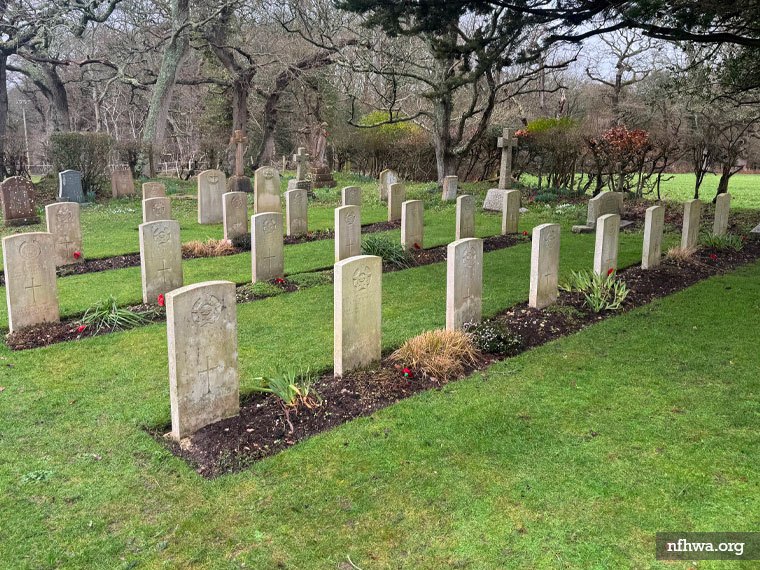
In amongst the many war graves in the St John the Baptist churchyard in Boldre, New Forest, there’s one that stands out from the rest for a couple of reasons. The first is the age of the man buried. Or perhaps I should say boy. He was just eighteen. But his date of death is also more noticeable, because he died before the fighting began as part of the Normandy invasion.
Private Kenneth Townsend
On 29 May 1944, with the 2nd Battalion Gloucestershire Regiment sealed into its embarkation camps in advance of D-Day, Kenneth Townsend was accidentally killed in a rifle discharge. His grave lies in the Commonwealth War Graves corner in the churchyard of St John the Baptist, Boldre. His grave is just under two miles away from where he died; the camp where his battalion waited before getting their orders to move.
His headstone sits a little apart from the clusters of aircrew graves that many visitors come to see. This is why his grave might initially catch the eye, and upon closer inspection, you see the detail: a young soldier, dying a week before D-Day.

A boy from Charfield, Gloucestershire
Kenneth Townsend was from Charfield in Gloucestershire (now South Gloucestershire in modern administrative terms). The South Gloucestershire War Memorials project describes him as being the son of Thomas and Lilian Townsend, and notes how he had previously lived in Bristol.
He is commemorated on the Charfield war memorial, and local transcriptions repeat his wartime detail: Private Kenneth Townsend, 2nd Gloucestershire Regiment, service number 14656343, died 29 May 1944, age 18, buried at Boldre (St John) Churchyard, Row 4, Grave 1.
The battalion he joined
By spring 1944 the 2nd Battalion Gloucestershire Regiment belonged to 56th (Independent) Infantry Brigade. The brigade’s job for D-Day was to land, get off the beach, and push inland.
The Gloucesters’ own regimental and veterans’ material tends to summarise the battalion’s opening days in Normandy in brisk terms: the 2nd Battalion came ashore on D-Day as part of 56th Brigade and was among the first Allied troops to enter Bayeux the following day. That tells you what Kenneth Townsend was training for, and how close he was to it before he died.
The brigade and its battalions had been training for years, and in May 1944 the last phase began – sealing camps, cancelled leave, controlled movement, and final briefings delivered, from battalion down to platoon, then to every man.
“Bogus maps” and sealed camps in the New Forest
The battalion was in Camp B7. Camp B7 (Brockenhurst B) had a capacity of 1,100 men and 159 vehicles and was located in fields in the grounds of Brockenhurst Park. Briefings begin with the issue of the plan for D-Day and continue with “BOGUS maps” used for security. Platoon commanders were briefed, then the rest of the battalion, then senior officers addressed the unit. The camp was sealed in late May, and records the move on 3 June to Lymington for embarkation in Landing Craft Infantry (LCIs), before sailing to Southampton Docks.
This is the atmosphere Townsend lived in during his last days: waiting, briefings, rehearsed routines, and undoubted tension.
It is in that setting that the accident happened.
The accident
We are unusually fortunate, in a grim way, in that the death is described in a first-hand recollection preserved in a published academic dissertation on 56th Brigade. This is blunt, the way soldiers often spoke about accidental death in camp because there was nothing else to do with it.
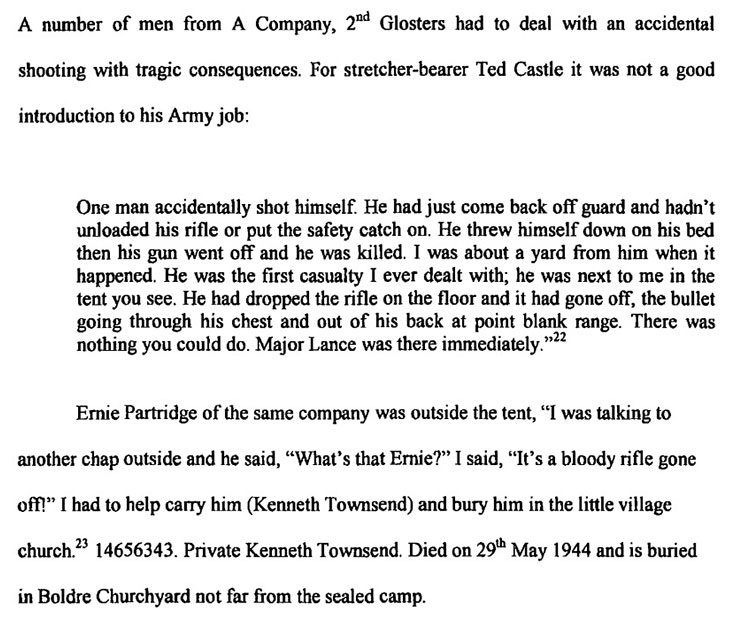
A stretcher-bearer, Ted Castle, recalled how a man returned from guard duty and had not unloaded his rifle or applied the safety catch. The man threw himself down on his bed and the weapon discharged. Castle was only about a yard away.
Another man of the same company, Ernie Partridge, remembered being outside the tent, hearing the shot, and helping to carry Townsend and bury him “in the little village church”. The dissertation then identifies the casualty by name and number: “Private Kenneth Townsend (14656343) died on 29 May 1944 and is buried in Boldre Churchyard, not far from the sealed camp.”
Two things are worth saying plainly.
First, the sources describe Townsend accidentally shooting himself.
Second, accidental deaths like this were not rare in wartime training, but they were rarely remembered in public because they did not fit the heroic frame. A battalion could absorb an accident and still be expected to sail on schedule. That is part of why a solitary grave in an English churchyard can feel so striking now.
Burial at Boldre
Townsend lies in Boldre (St John) Churchyard. Row 4, Grave 1. His grave inscription includes his family’s chosen epitaph:
CALLED TO DUTY,
FAR AWAY FROM THOSE
WHO LOVED HIM
FROM DAY TO DAY
Townsend died on 29 May. The battalion was still in the sealed camp system and would embark on 3 June. That is just days. For the men of his tent, his section, his platoon, there was no time to process anything. They buried him locally, returned to routine, and then sailed for Normandy.
I have been unable to find a photo of Kenneth Townsend. Please contact if you can help or tell me more about him.
Credits & references
- ’56th Infantry Brigade and D-Day: An Independent Infantry Brigade and the Campaign in North West Europe 1944-1945′, by Andrew Holborn
- Stephen Fisher
- https://www.cwgc.org
- https://sites.southglos.gov.uk/war-memorials/people/kenneth-townsend “
- https://www.glosgen.co.uk/warmem/charfieldwm.htm
- https://soldiersofglos.com/announcement/invasion-liberation
- https://www.cheshireroll.co.uk/soldier/?i=34770%2F5186439-sergeant-stanley-west
- https://www.normandywarguide.com/war-diaries/2nd-bn-gloucestershire-regiment-june-44