
The SOE in Beaulieu: The Finishing School for Secret Agents
The village of Beaulieu in the New Forest mattered to the Special Operations Executive (SOE) because it looked like it didn’t matter at all. A country estate on the edge of the New Forest in Hampshire, a village, quiet roads, woods, water, and a scatter of houses. That ordinariness was the point. It let the SOE train people for clandestine work without building anything that looked like a school, a camp, or a headquarters.
In SOE shorthand, Beaulieu became a cluster of “finishing schools” (Special Training Schools, STS) where agents who had already survived selection and earlier training were pushed through the last stage before being sent into occupied Europe. It’s believed that the number of trainee agents who passed through Beaulieu as being at around 3,000,
What the SOE wanted Beaulieu for
The SOE was created in 1940 to conduct sabotage and subversion overseas, working with resistance movements, and it sat awkwardly between the habits of peacetime intelligence and the demands of total war. The National Archives’ own education material summarises the broad purpose cleanly: SOE’s work took place in occupied countries and involved propaganda, sabotage, and supporting resistance.
Beaulieu was not where you learned to fire a Sten or use plastic explosives. Those hard-edged skills belonged earlier in the training pipeline. The Beaulieu finishing school phase was about classes offeering something less dramatic and, in practice, harder: living a cover, keeping your head, and behaving in a way that didn’t attract attention.
The information panels in the Beaulieu SOE Museum list the classes agents would take as:
- SECTION A: Forgery, Security, Survival, Criminal Skills, Disguise, Key Making and Silent Killing
- SECTION B: Reconnaissance, House Breaking, Safe Breaking, Burglary.
- SECTION C: Enemy Organisation, Identification and Uniforms.
- SECTION D: Propaganda, Political Warfare and Unattributable Sabotage.
- SECTION E: Codes, Ciphers, Secret Inks, and Invisible Writing
For some of the training, agents at Beaulieu were sent elsewhere to practice field skills. For example, Noor Inayat Khan was sent to Bristol to practice setting up safehouses and undercover wireless operations. Other agents were sent to Bournemouth for the day to learn evasion techniques.
That detail matters. The SOE wanted their agents to practise in real streets, with real people around them, and all the small frictions that come with that. If you can’t handle the ordinary world, you can’t hide in it.
Why the Beaulieu worked as a school without looking like one
Beaulieu’s usefulness sits in its geography and its ownership.
The estate was large enough to disperse training across multiple houses. It had woodland, open ground, lanes, and access to the sort of coastal and riverine terrain you could use for movement and concealment. And it belonged to Lord Montagu, which mattered because it put a single landlord at the centre of a wartime requisitioning relationship. The “finishing schools” were housed in a series of large country houses scattered across the Beaulieu Estate.
The reason Beaulieu was chosen as one of several training centres in early 1941, was in part on the recommendation of Brigadier Gerald Buckland. He worked in administration for the SOE, and lived in Curtlemead, Beaulieu. Buckland knew of empty houses on the estate due to war, so recommended they be requisitioned.
Not all the houses used for the SOE were empty. They were in those days owned by the estate, and some of the tenants were asked to move out.
The location of the houses helped too. Many were at the end of dirt or gravel tracks, so could not be seen from the road, hidden under trees, giving them the perfect cover against prying eyes.
The wide dispersal of the properties served several purposes at once:
- it reduced the obvious “footprint” of any one site
- it allowed different courses to run in parallel
- it kept the area looking like what it was, a quiet estate with private houses, not a military camp
- it gave instructors the ability to move students between locations as part of the training, which itself reinforced security habits
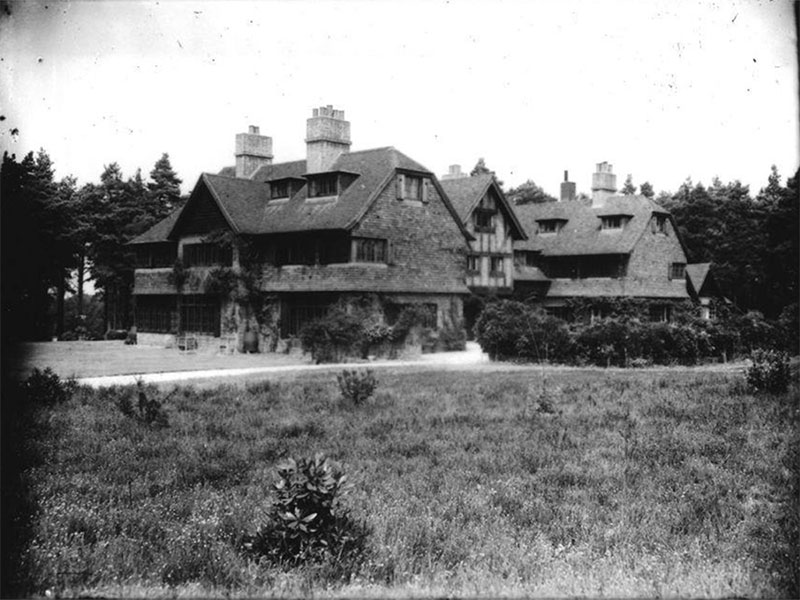
The Beaulieu finishing schools: the requisitioned houses
Readers often think of Beaulieu’s SOE activity and history through a single phrase, “the SOE finishing school”. It sounds like one place – and many people often equate that to being Palace House. In reality it was a small network of places, with STS numbers and house names that recur across establishment lists and local histories.
There is some debate as to whether Palace House was ever involved as part of the SOE at all. I have never found any evidence to suggest it was but am prepared to see evidence to the contrary if anyone has any.
| STS designation | House / site name | Google map |
|---|---|---|
| STS 31 | The Rings (demolished after the war) | https://maps.app.goo.gl/1TRXTJW6mrq4su9R6 |
| STS 31a | The House in the Woods (also seen as House in the Wood) | https://maps.app.goo.gl/3cZdkFZrXbgzapvD6 |
| STS 32a | Harford House | https://maps.app.goo.gl/PJ4DurvYaLsuynJQA |
| STS 32b | Saltmarsh | https://maps.app.goo.gl/Rd4zaD6gGMaekRXS9 |
| STS 32c | Blackbridge | https://maps.app.goo.gl/qCDvVkLxcEHzNhWw5 |
| STS 33 | The House on the Shore | https://maps.app.goo.gl/dUX7GFLgWWg7mP3W6 |
| STS 34 | The Drokes | https://maps.app.goo.gl/bDDsFpZdP21wT5Bi6 |
| STS 35 | Vineyards | https://maps.app.goo.gl/M4jhzSzGh2DxUuEFA |
| STS 36 | Boarmans | https://maps.app.goo.gl/jfGjwzyHzGBiSsow6 |
| STS 37a | Warren House | https://maps.app.goo.gl/bEALxZZCfT3uraQTA |
| STS 37b | Clobb Gorse | https://maps.app.goo.gl/rx33pczdE8QK5opg8 |
Please note, all of these houses are private residences. Please respect that and do not visit them.
What the Beaulieu SOE finishing school taught, in practical terms
Beaulieu’s finishing school training was less about bold acts and more about habits. Habits of speech, movement, and self-control.
Cover stories, disguise, surveillance and countersurveillance, contacting procedures, message drops, safe conduct, and the discipline of behaving like a person who belongs where they are.
The Guardian obituary of Noreen Riols, who worked as an SOE trainer, adds something that’s often missing from museum captions: how training was tested. It describes her work as a target for surveillance training and as part of the final test before agents were sent into the field, and it places the finishing school at Beaulieu while noting that exercises took place mainly in Bournemouth and Southampton.
Signals: why Vineyards keeps appearing
If you want one thread that explains the risk agents carried into the field, it’s wireless.
Vineyards is repeatedly connected with basic wireless and telegraphy training, and TracesOfWar.com also claims that most agents there were French, which fits the wider pattern of SOE’s country sections and the flow of F Section personnel.
Radio operators had a particular burden. They had to master code and procedure, keep sets working in poor conditions, and limit transmission time. None of that is glamorous, but the war is full of examples where the radio was both lifeline and liability. A finishing school that treated wireless as a serious discipline was doing the job it existed to do.
Women at Beaulieu: Boarmans as a working space, not a footnote
Boarmans is often described as the women’s finishing school site within the Beaulieu group. They did the same work of cover, security, and tradecraft, and then they were sent into the same occupied landscape with the same danger as men.
Beaulieu’s legacy: what remains and what we can reasonably say
Beaulieu’s SOE history lives in three places at once:
- in the surviving landscape, which still looks like a place where you could hide activity in plain sight
- in the private houses, most of which you cannot and should not treat as attractions
- in the public interpretation at Beaulieu’s SOE Museym, where the story is now curated and presented
The Secret Army Exhibition
Beaulieu describes the Secret Army Exhibition as telling the story of Beaulieu’s role as a top secret training establishment for SOE agents, and it repeats the headline figure of “over 3,000” trained there.
Be aware, you are not going to “tour the spy houses”. You are going to a museum and historic estate complex that interprets one part of its wartime role. It’s a fantastic museum.


