
The Toy Pistol Bluff: the Heinkel at the Horse & Jockey, 12 July 1940
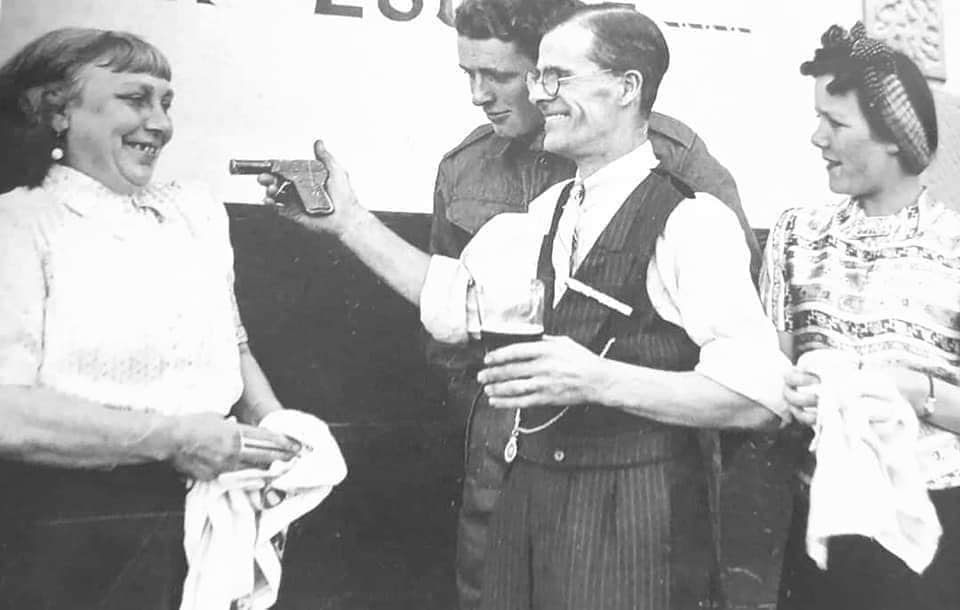
On the afternoon of Friday 12 July 1940, a German bomber belly-landed in a Hampshire field beside a country pub, and two unarmed local men walked over and took the crew prisoner. One of them was carrying a toy pistol.
It sounds like something from a wartime comedy script. It was in the national papers by the following morning, and eighty-six years on, the contemporary reports and the surviving photographs let us reconstruct it in unusual detail.
The aircraft
The bomber was a Heinkel He 111P, coded G1+FA, belonging to the Geschwaderstab of Kampfgeschwader 55 “Greif” – one of the Luftwaffe’s longest-serving bomber wings, then operating from airfields in northern France. On 12 July it was flying an armed reconnaissance over Southampton Water when it was intercepted by Hurricanes of ‘B’ Flight, No. 43 Squadron, operating out of Tangmere.
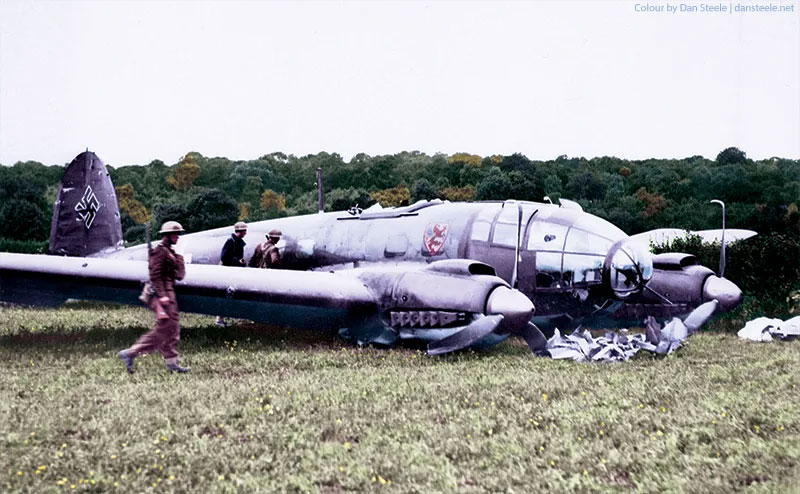
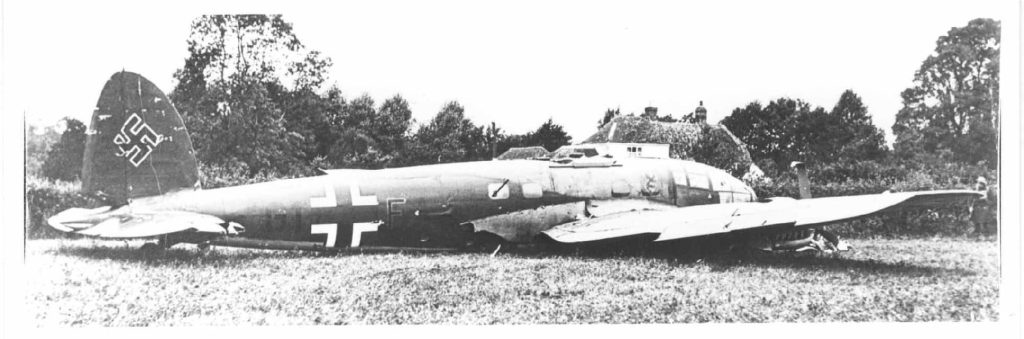
Damaged and losing the fight, the Heinkel put down on its belly in a field at Hipley, near Denmead – right next to the Horse & Jockey inn. The photographs taken shortly afterwards show it remarkably intact: propellers bent, undercarriage up, but the airframe whole, sitting in the grass with a farmhouse roof visible over the hedge behind it.
“Come on. Let’s get those Jerries.”
What happened next was reported the following day, Saturday 13 July 1940, in papers from the Liverpool Echo to the Swindon Advertiser, under headlines such as “TOY PISTOL BLUFF” and “TOY PISTOL BLUFFED NAZI AIRMEN.”
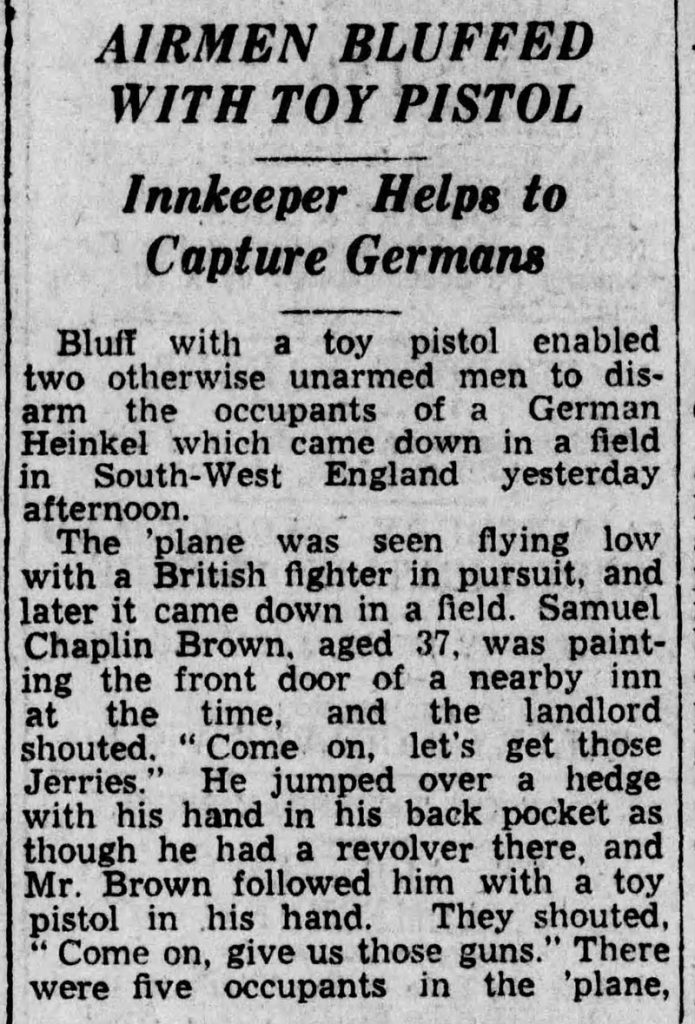
The reports name Samuel Chaplin Brown, aged 37, who was painting the front door of the nearby inn when the aircraft came down. The landlord – unnamed in the press, but described as an ex-serviceman of 47 – shouted “Come on, let’s get those Jerries,” and went over the hedge with his hand in his back pocket, as if he had a revolver there. Brown followed him carrying a toy pistol. They called on the crew to hand over their guns.
Remarkably, it worked. The uninjured Germans surrendered their revolvers, and the two Englishmen then covered the crew with the airmen’s own weapons while Brown flagged down a passing motorist and sent him for assistance.
The press reported five men aboard: one dead, one – described as the pilot – seriously injured, and the remainder placed under arrest. Later research identifies the man killed as Oberleutnant Kleinhans, with the other four crew members taken prisoner. Given wartime reporting restrictions (the papers would only say the aircraft came down “in South-West England”), the confusion over who held which crew position is hardly surprising.
One detail from the landlord’s account stuck in the papers. A German nearly 6ft 6in tall climbed out of the aircraft, made a circular motion with his hands, and said “No good.” The landlord suspected he was signalling to another aircraft in the area. It probably meant nothing more than a resigned airman indicating that the game was up – but in July 1940, with invasion expected, nobody was inclined to take chances.
The night the pub ran dry
The final paragraph of the reports is the one that made the story travel. That evening, hundreds of people descended on the tiny country inn to hear the tale from the men themselves, and before closing time a fortnight’s supply of beer had been sold.
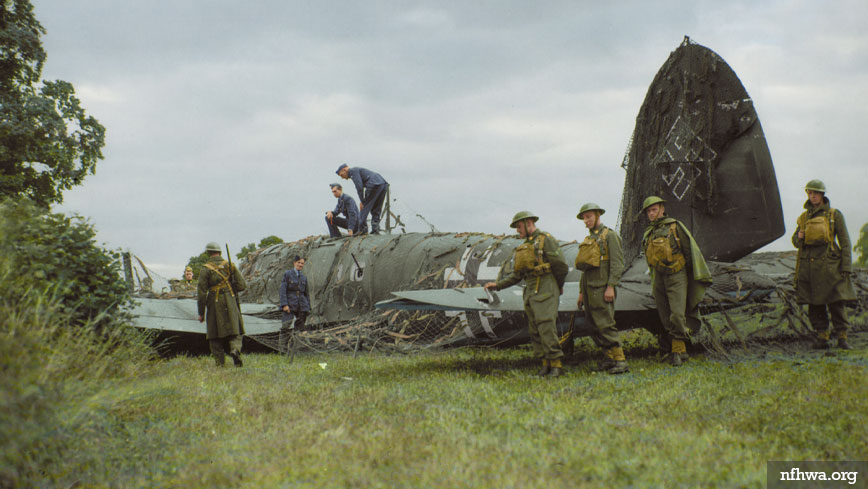
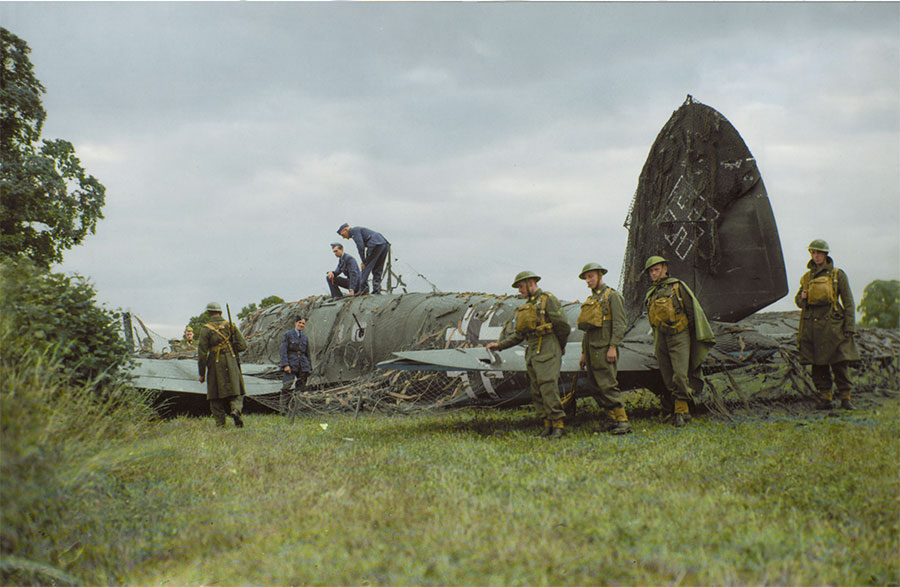
The aircraft itself became an attraction in its own right – enough of one that the local Home Guard mounted a watch to keep souvenir hunters at bay. Official photographs show it was camouflaged with netting and foliage where it lay, to prevent the Luftwaffe from finding and destroying it from the air, before it was taken away for evaluation. An intact He 111 was a genuine intelligence prize in the summer of 1940, and this was reputedly among the best-preserved German bombers brought down over Britain up to that point.
What the eyewitnesses add – and where the story shifts
Stories like this one get retold for decades, and details drift. Some later accounts place the crash beside the Chairmakers, the neighbouring pub – but Brian Crook, who lived close by at Shoothill Lodge as a child, was clear: the aircraft belly-flopped in the field adjoining the Horse & Jockey. He also recalled the landlord’s name as Mr Tibbles, and remembered the famous pistol as an air pistol – one which, together with a piece of the Heinkel, hung on the wall of the Jockey for years afterwards, until Tibbles left.
So, was it a toy pistol, an air pistol, or – as one retelling has it – a water pistol? The contemporary reports all say toy pistol; the man who remembered seeing it on the pub wall says air pistol. Perhaps both are describing the same object. It’s a good reminder of how a story can change over time.
What is beyond doubt is the core of it: on a July afternoon in 1940, a Luftwaffe bomber came down beside a Hampshire pub, and its crew was disarmed by a publican with his hand in his pocket and a decorator holding a toy gun.
Sources
- Contemporary newspaper reports, Saturday 13 July 1940, including the Liverpool Echo (“Toy Pistol Bluff – German Airmen Captured – Innkeeper’s Ruse”), the Swindon Advertiser, and The Mail (Millom & South Copeland edition)
- Eyewitness recollection of Brian Crook, resident of Shoothill Lodge in 1940
- Aircraft identification: He 111P G1+FA, Stab/KG 55, shot down by ‘B’ Flight, No. 43 Squadron (Bentley Priory Museum; Battle of Britain day-by-day records)
- Contemporary photographs of the aircraft at Hipley, including IWM images showing the camouflaged airframe under guard


